
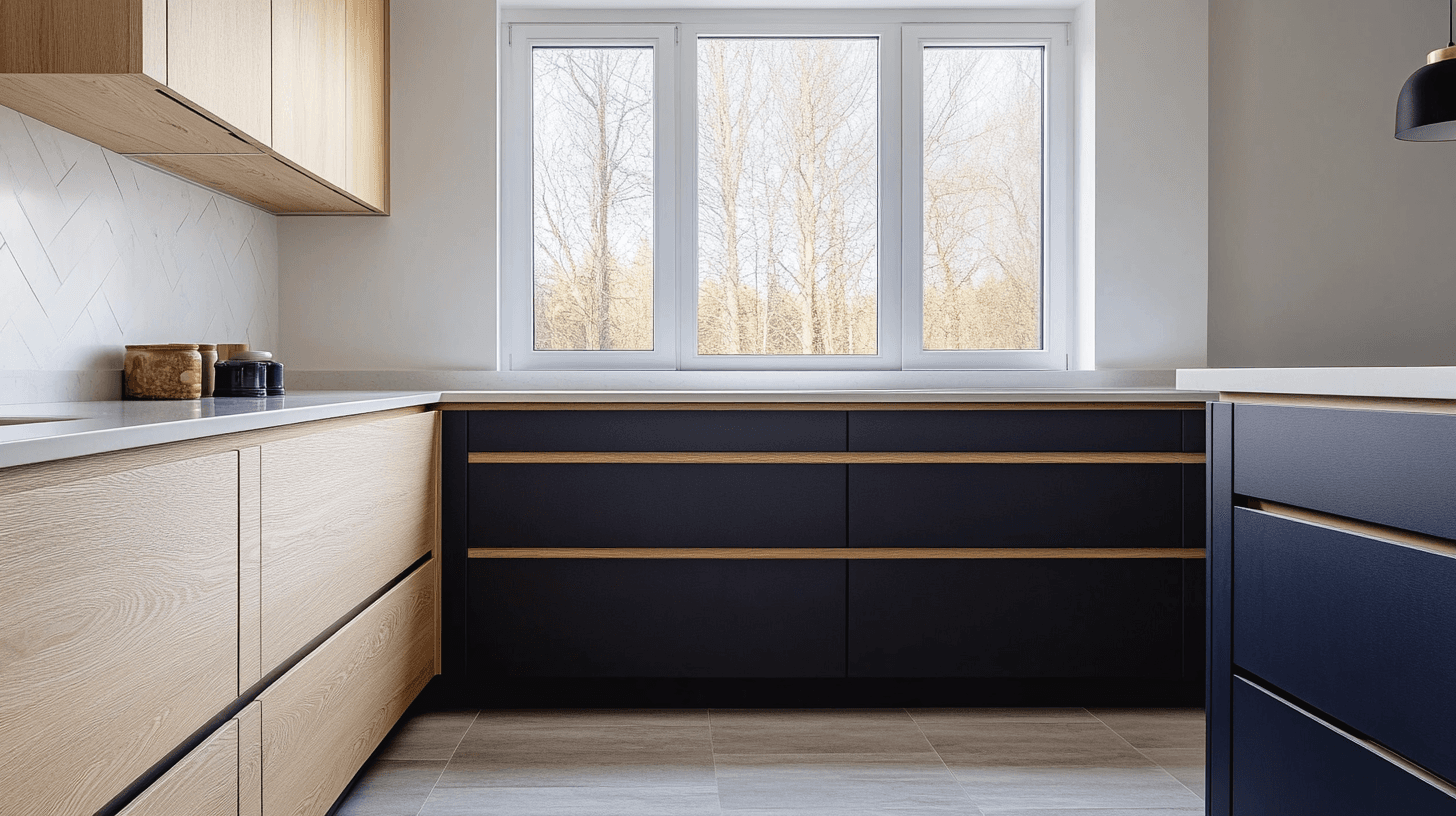
The three cabinet tiers explained from a supplier’s perspective — what each one actually delivers, where the real cost differences are, and how to choose without overpaying or undershooting.
At ZMC Cabinetry’s showrooms in Fremont (Alameda County) and Rancho Cordova (Sacramento County), we help homeowners navigate this exact decision every day. Based on projects completed at ZMC Cabinetry over the past several years, the majority of our customers choose semi-custom cabinetry — with stock and custom each representing a meaningful minority — and in every case, the right answer depends on dimensions, timeline, budget, and how long you plan to stay in the home. This guide reflects what we actually see and recommend, not a generic tier comparison. We update it when market pricing or product availability changes; last reviewed May 2026.
At ZMC Cabinetry, the stock vs. semi-custom vs. custom question is the first real decision in almost every consultation we run across our Fremont and Rancho Cordova showrooms. Most homeowners arrive with a strong sense of their budget but an incomplete picture of what each tier actually includes — and more importantly, what changes when you move from one to the next.
This guide answers that question directly. Not as a sales pitch for any particular tier, but as a frank account of what each one delivers, where the price differences actually come from, and what we’ve seen go wrong when homeowners choose the wrong tier for their project.
The Three Tiers at a Glance
All prices reflect typical installed pricing in Northern California as of May 2026. Actual costs vary by kitchen size, finish selection, and contractor rates. See our full California cabinet cost guide for a complete breakdown by region.
| Feature | Stock | Semi-Custom | Custom |
|---|---|---|---|
| Installed cost (NorCal) | $100–$300 / LF | $200–$750 / LF | $600–$1,400+ / LF |
| Sizing | Fixed 3″ increments, gaps filled with trim | 1″ increments on qualifying lines — not all semi-custom lines offer this, ask specifically | Any dimension |
| Lead time | In-stock to 3 weeks | 4–8 weeks | 10–20 weeks |
| Box construction | Varies — ask | Plywood (mid-range and above); often particleboard at entry level | Plywood or solid wood |
| Finish options | Limited catalogue | Dozens of colours and profiles | Unlimited |
| Interior fittings | Basic | Pull-outs, soft-close, organisers available | Fully configured to spec |
| CARB2 compliant (California Air Resources Board Phase II) |
Ask specifically | Yes (all ZMC lines) | Yes (all ZMC lines) |
What “RTA” means and how it differs from stock: Ready-to-assemble (RTA) describes how a cabinet ships — flat-packed for assembly on-site. It’s a delivery method, not a quality tier. Stock cabinets can arrive RTA or pre-assembled. When comparing quotes, make sure you’re comparing installed cost either way, because RTA labour adds to the final number.
Tier One: Stock Cabinets — What You Get and When They’re the Right Call
Stock cabinets are pre-manufactured in fixed sizes — typically 3-inch width increments from 9″ to 48″ — and held in inventory until purchase. They’re the fastest and least expensive way to get a kitchen done. Whether that’s the right choice depends on what you’re renovating and why.
$100–$300 / LF installed (NorCal)
- What you get: Fixed standard sizes (3″ increments), limited door profiles and finishes, fast availability (days to 3 weeks), lowest entry price. Some stock lines use plywood boxes — some use particleboard. Always ask which before buying.
- What you give up: Exact fit — filler strips and trim bridge the gaps. Limited interior storage upgrades. Quality ceiling that varies significantly by brand and line.
- Right for: Rental properties, investment flips, secondary spaces (laundry, mudroom, garage), kitchens with standard dimensions and a tight timeline or budget, or homeowners planning to sell within 2–3 years and needing a presentable refresh rather than a long-term installation.
One quality check worth doing at the showroom: ask your consultant for the construction specifications on any cabinet line you’re considering — specifically whether the box uses plywood or furniture-grade particleboard. Plywood resists moisture and holds fasteners better over time; particleboard is lighter and less expensive but more vulnerable under sustained load and humidity. The material difference matters significantly over a 10-year horizon, particularly for base cabinets.
Tier Two: Semi-Custom Cabinets — Where Most NorCal Renovations Land
Semi-custom cabinets use a manufacturer’s standard box as the starting point, then allow modifications — different sizes, additional door styles, wider finish ranges, interior fitting options — within a defined catalogue of choices. The word “semi-custom” covers a wide range: some lines offer genuine 1-inch sizing flexibility and deep configurability; others are stock cabinets with a broader paint palette and a premium label. The gap between the best and worst semi-custom lines is larger than the gap between a good semi-custom and a simple custom line.
$200–$750 / LF installed (NorCal) · 4–8 week lead time
- What you get: Adjustable sizing (often to 1″ increments on quality lines), dozens of door profiles and paint colours, plywood box construction on mid-range and above, soft-close hardware, pull-outs and organiser inserts.
- What you give up: Truly non-standard dimensions still require workarounds. Each modification carries an individual upcharge — add enough of them and the quote climbs fast.
- Right for: Primary residences where you plan to stay 5+ years, kitchens with slightly non-standard dimensions, homeowners who want a specific finish or door profile that stock can’t provide, and anyone who wants to see and touch their cabinet line before committing.
The semi-custom cost trap — what we see in our showrooms
Semi-custom cabinets are priced as a base cost plus individual upcharges for each modification. Add a non-standard width here, a specialty finish there, then a full set of interior pull-outs — and each change adds a discrete line item to the quote. In some projects we’ve quoted, extensive semi-custom modifications have resulted in pricing comparable to — or higher than — what a simpler custom line would have cost, because the per-modification upcharges compounded without anyone flagging the inflection point.
Our rule of thumb: if you find yourself modifying more than a third of a semi-custom line’s standard specifications — sizes, finishes, and interiors combined — ask us to run a parallel custom quote. It happens more often than most homeowners expect, and catching it early saves several thousand dollars.
Not all semi-custom lines are equal. ZMC evaluates every line we carry before it goes on the showroom floor, and the honest picture is this: some “semi-custom” products are stock cabinets with a wider colour range. Others offer genuine 1-inch sizing increments, depth adjustments, and full interior configurability that approaches what custom work delivers. When you’re getting quotes, ask specifically: what sizing increments are available? What box material is standard? Which interior options require an upcharge vs. which are included?
Tier Three: Custom Cabinets — When They’re Worth Every Dollar
Custom cabinets are built from scratch to your kitchen’s exact specifications — every dimension, every material, every interior detail is determined by your project rather than a manufacturer’s production line. There is no catalogue to flip through. If the ceiling height is non-standard, the island is curved, or the door profile you want doesn’t exist in any semi-custom line, custom is the path.
$600–$1,400+ / LF installed (NorCal) · 10–20 week lead time
- What you get: Precise fit to every wall, ceiling height, and structural constraint. Any door profile, any material (solid wood, specialty veneers, reclaimed wood), any interior configuration.
- What you give up: Time and active involvement. Custom requires design approval before manufacturing begins, and any revision after that point adds cost. Most custom projects take 10–20 weeks from design sign-off.
- Right for: Long-term homeowners (10+ year horizon), kitchens with genuinely non-standard dimensions or architectural constraints, design-forward renovations where the cabinetry is the centrepiece, and high-value homes where the kitchen quality needs to match the property.
A note on custom vs. quality: tier label does not equal durability. A well-specified semi-custom cabinet in a plywood box with full-extension slides will outlast a poorly specified custom cabinet in MDF with budget hardware. What drives longevity is box material, finish quality, and hardware — not the tier. At any tier, ask about box construction before you assume the more expensive option is the better-built one.
Real Numbers: What the Same Kitchen Costs Across All Three Tiers
To make the cost comparison concrete rather than abstract: here is a representative 22-linear-foot NorCal kitchen — standard layout, painted finish, mid-range interior fittings — quoted across all three tiers at ZMC. These are illustrative ranges based on typical ZMC project quotes; your actual number will vary based on finish selection, interior upgrades, and your specific layout.
- Stock — $12–18K (22 LF installed): standard sizes with filler trim, limited door/finish options, basic interior with no pull-outs, available within 1–3 weeks.
- Semi-Custom — $22–35K (22 LF installed, most common at ZMC): sized to your walls (1″ increments), choice of door profile and painted finish, soft-close hardware standard, pull-outs and inserts available, plywood box, 4–8 week lead time.
- Custom — $40–65K+ (22 LF installed): exact dimensions, any configuration, any door profile/wood species/finish, fully designed interior storage, premium hardware included, 10–20 week lead time.
The cost gap between stock and semi-custom is usually $10,000–$20,000 on a typical NorCal kitchen. The gap between semi-custom and custom is $15,000–$30,000+. What you’re buying at each step is not just better materials — it’s better fit, more finish options, and a longer useful life. Whether that’s worth it depends entirely on how long you plan to use the kitchen.
Mixing Tiers to Optimise Your Budget
One of the most cost-effective strategies we recommend — and one that most generic guides skip over — is specifying different tiers for different parts of the same project. Not all cabinets in a kitchen are equally visible, equally used, or equally worth the upgrade.
- Kitchen base cabinets — semi-custom or custom. These take the most daily stress — moisture, weight, repeated use. Worth the upgrade from stock.
- Kitchen wall cabinets — semi-custom. Lighter duty than base cabinets but highly visible. Semi-custom gives you the finish and door profile match without full custom cost.
- Kitchen island — custom or featured semi-custom. Often the visual centrepiece and the highest-return location for a custom upgrade.
- Pantry and tall cabinets — semi-custom. Large surface area means small price-per-door differences add up fast.
- Laundry and utility rooms — stock. These spaces don’t need the same finish quality or dimensional precision.
- Bathroom vanities — semi-custom. Tighter dimensions and more moisture exposure than utility rooms make the plywood construction worth it.
The most common mixed-tier approach at ZMC: semi-custom throughout the kitchen, custom island. The island reads as a designed statement piece; the perimeter delivers quality at a sensible cost. For homes with a separate utility or laundry room, adding stock there can recover $3,000–$8,000 from the overall budget without any visible compromise in the main kitchen.
From Our Showroom: A Real Example
A Fremont homeowner came to our showroom with a clear vision: semi-custom cabinetry throughout a 24-linear-foot kitchen with a large island. They had a specific painted finish in mind, needed several non-standard widths to work around an existing window bay, wanted full-extension pull-outs in every base cabinet, and had chosen a door profile only available as an upcharge on their preferred line.
By the time we worked through the quote, the semi-custom configuration had accumulated modifications on roughly half the cabinet run. We ran a parallel quote on a straightforward custom line — same footprint, comparable finish, equivalent interior fittings. The custom option came in within 8% of the modified semi-custom quote, with better dimensional precision and a longer lead time of four additional weeks.
The homeowner chose custom. Not because semi-custom was the wrong starting point — it was the right instinct — but because the specific combination of modifications had moved the project into custom territory without anyone flagging it. This is exactly why we run parallel quotes when we see modification counts climbing.
Which Tier Is Right for Your Project
The right choice is not about which tier is “better” in any absolute sense. It’s about matching the investment to the use case.
Choose stock if: it’s a rental property or investment flip; you’re selling within 2–3 years; budget is the primary constraint; the kitchen has standard dimensions; it’s a utility or secondary space; you need it installed quickly.
Choose semi-custom if: it’s your primary home, staying 5+ years; you have specific finish or door preferences; dimensions are slightly non-standard; you want to see the product before ordering; interior storage matters to you daily; budget is $20K–$40K for a typical kitchen.
Choose custom if: you’re staying 10+ years; kitchen dimensions are genuinely non-standard; the design is architecturally centred on the kitchen; you have a specific material not in any semi-custom line; the home’s value justifies the investment; budget allows $40K+ for the kitchen alone.
Frequently Asked Questions
What is the difference between stock, semi-custom, and custom cabinets?
Stock cabinets are pre-built in fixed standard sizes and held in inventory — fast, affordable, limited in fit and finish. Semi-custom cabinets use a manufacturer’s standard base but allow modifications to size (typically within 1-inch increments on quality lines), door profile, finish, and interior fittings within a defined catalogue. Custom cabinets are built from scratch to exact specifications with no dimensional constraints and unlimited material options. Industry standards for cabinet construction quality are set by the Kitchen Cabinet Manufacturers Association (KCMA).
Is semi-custom always better than stock?
No. Stock cabinets are the correct choice for rental properties, investment flips, secondary spaces, tight timelines, and standard-dimension kitchens. The semi-custom premium buys you sizing flexibility, a wider finish range, better box construction, and interior storage options — none of which are worth paying for if your project doesn’t need them. The upgrade from stock to semi-custom typically adds $10,000–$20,000 to a standard NorCal kitchen.
Can semi-custom cabinets end up costing more than custom?
Yes — and we see this happen regularly. When a homeowner adds non-standard sizes, a specialty finish, a full interior fitting package, and several door profile changes, the upcharges accumulate independently rather than being absorbed into a single project cost the way custom work is quoted. If you find yourself modifying more than a third of a semi-custom line’s standard specifications, ask for a parallel custom quote.
How much more do semi-custom cabinets cost than stock in California?
In NorCal, a well-specified semi-custom kitchen typically runs 50–100% more than a stock kitchen of the same footprint — not primarily because of the door, but because of better box construction, a wider finish range, and interior fittings that stock lines don’t include. On a 22-linear-foot kitchen, that translates to roughly $10,000–$20,000 more installed.
Are custom cabinets worth it if I plan to sell in 5 years?
Rarely — unless the home’s price point genuinely demands it. For a home being prepared for sale, a well-executed semi-custom kitchen in a neutral painted finish typically delivers comparable buyer appeal at $20,000–$30,000 less. According to the 2025 Cost vs. Value Report, kitchen renovations recoup approximately 60–80% of their cost at resale, and that return applies regardless of whether the cabinets are semi-custom or custom — the quality of the overall renovation matters more to buyers than the tier of the cabinetry.
The fastest way to get a real answer is to bring your kitchen dimensions and budget range to either ZMC showroom. We can show you all three tiers in person, run a preliminary quote across the options, and tell you honestly which one fits your project. Book a free consultation.