
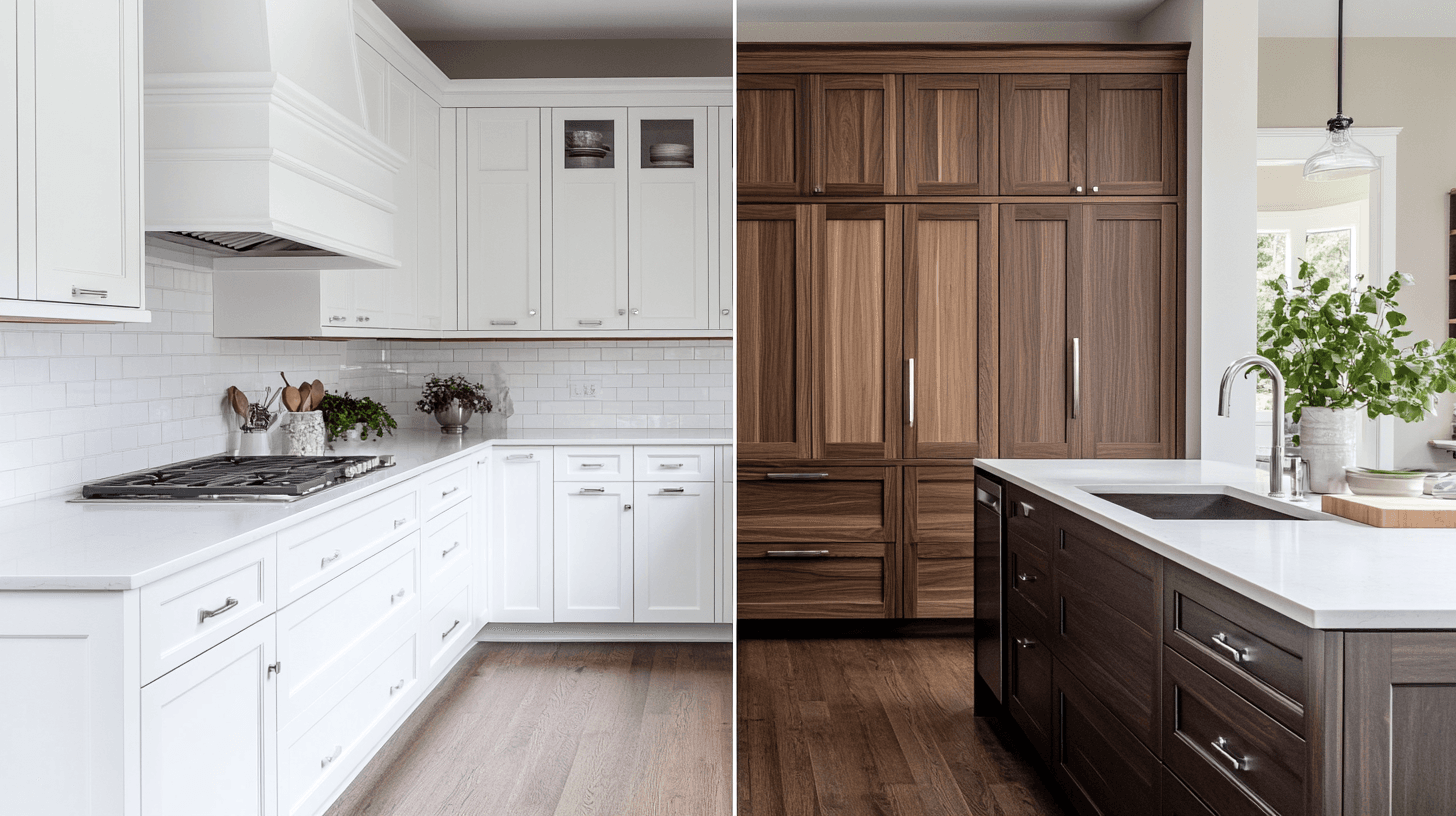
A straight comparison of the two most popular cabinet door styles — covering design, cleaning, cost, resale value, and which one fits NorCal homes best.
At ZMC Cabinetry’s showrooms in Fremont (Alameda County) and Rancho Cordova (Sacramento County), shaker and flat-panel cabinets are the two most common door style decisions we help homeowners navigate. This guide reflects what we see in the showroom and in completed projects across both NorCal markets — not a generic national summary. We update this guide when market trends or product availability changes; last reviewed May 2026.
At ZMC Cabinetry, the shaker vs. flat-panel question comes up in almost every kitchen consultation we run across our Fremont and Rancho Cordova showrooms. Most homeowners arrive with a gut feeling about which direction they want — but enough uncertainty that they need the trade-offs spelled out before committing to a door style they’ll look at every day for the next decade.
This guide does that. Both styles are genuinely good choices in the right context. The goal here is to give you a clear framework for deciding — based on your home’s architecture, your lifestyle, your timeline, and your local market — not to push you toward either one.
At a Glance: What Each Style Actually Is
Shaker — five-piece door, recessed centre panel. The frame creates a subtle shadow line and depth. Works in traditional, transitional, farmhouse, and many modern settings. Widely regarded across the cabinet industry as the most commonly installed door style in the United States — available painted, stained, or in natural wood, and not driven by any single trend cycle.
Flat-Panel (Slab) — single-piece door, smooth uninterrupted face. One continuous surface — no frame, no groove, no recess. Emphasises grain pattern on wood species; reflects light on high-gloss. Suits modern, contemporary, Scandinavian, and minimalist settings. Growing fast: 69% of design professionals cite flat/slab cabinet door styles as gaining popularity, per NKBA’s 2026 Kitchen Trends Report. White oak slab is currently the fastest-growing specification at ZMC.
The most important thing to understand is what each door profile communicates architecturally. Shaker’s recessed panel creates visual depth without ornamentation — it reads as traditional in a wood tone, transitional in a soft painted finish, and nearly modern in a slim white profile. That’s why it suits such a wide range of homes. Flat-panel does the opposite: it removes all visual interruption from the door face, which makes the finish and grain pattern do all the work.
Shaker Cabinets: Strengths, Trade-Offs, and Who It’s For
Strengths: versatile across many design styles and architectural contexts; broad resale appeal — most buyers recognise and accept it; hides minor wear and small dings inside the frame; repaints cleanly, since the frame gives painters defined edges to work with; works with a wide range of hardware profiles without looking wrong.
Trade-offs to plan for: the inner groove collects grease, crumbs, and dust and requires deliberate wiping; five-piece construction uses slightly more material than a slab door; in very contemporary architecture it can read as too traditional; it’s also the most common choice — if originality matters to you, that’s worth noting.
What we see at ZMC Fremont: shaker remains the dominant choice in our Fremont showroom, particularly in painted finishes — white, off-white, and two-tone (painted uppers with a stained or contrasting island) continue to be the most requested configurations. The Bay Area’s mix of Craftsman bungalows, 1980s–90s tract homes, and transitional renovations creates a natural home for shaker’s versatility.
One thing worth saying plainly: shaker is not “safe” in a boring sense. It’s genuinely the right choice for a large share of NorCal kitchens because of what the regional housing stock looks like. If your home has traditional trim, built-in cabinetry in other rooms, or a distinctly Craftsman or farmhouse aesthetic, shaker is not a compromise — it’s the correct architectural decision.
Flat-Panel Cabinets: Strengths, Trade-Offs, and Who It’s For
Strengths: easiest to clean — one smooth surface, no grooves to trap grease; showcases wood grain fully, ideal for white oak, walnut, and natural veneers; creates a strong contemporary or minimalist aesthetic when executed well; works with integrated hardware for a handleless kitchen look; often marginally less expensive per door at comparable quality tiers.
Trade-offs to plan for: shows scratches, dings, and surface wear more visibly than shaker; hardware selection is less forgiving — the wrong pull or knob reads immediately; high-gloss finishes show fingerprints and require frequent wiping; can clash with traditional trim, moulding, or ornate architectural detail; thermofoil flat-front (budget tier) can peel — ask specifically about substrate.
What we see at ZMC Rancho Cordova: flat-panel orders have grown meaningfully at our Rancho Cordova showroom over the last 18 months, driven primarily by new-construction customers in the Sacramento suburbs who want a kitchen that matches their home’s contemporary architecture. White oak slab is the specification we’re seeing most — it threads the needle between warmth and minimalism in a way that painted flat-front sometimes doesn’t.
A practical note for California homeowners: finish durability on flat-panel cabinets varies more than it does on shaker. High-gloss lacquer finishes require low-VOC coating formulations in California, consistent with the state’s air quality regulations — ask your supplier which coating system they use and whether it’s been tested in high-heat environments. In Sacramento homes with west-facing windows, we’ve seen temperature cycling cause hairline expansion lines in cheaper high-gloss doors. All ZMC flat-panel lines are CARB2 compliant and use coatings appropriate for California’s climate zones.
Cleaning and Maintenance: The Honest Comparison
This is the question that sounds minor but matters a great deal over a ten-year ownership horizon. The difference in cleaning effort between the two styles is real — but it cuts both ways.
- Daily wipe-down: shaker requires attention to the inner groove with a damp cloth and gentle motion; flat-panel wipes clean in one pass — fastest to maintain day to day.
- Grease and cooking residue: the groove near the cooktop on shaker accumulates grease and needs monthly deep cleaning; flat-panel has no grooves, so residue stays on the surface and is easy to remove.
- Hiding minor wear: shaker’s frame profile conceals small dings, chips, and finish wear; flat-panel’s smooth surface makes every scratch visible and shows age more quickly.
- Fingerprints: similar on matte finishes for both styles; on high-gloss, flat-panel shows every print and needs frequent wiping (high-gloss is rarely specified in shaker).
- Repainting: shaker’s clean edges and defined frame let painters work faster and achieve better results; flat-panel’s smooth surface requires careful prep, since any imperfection shows.
Practical verdict: if you cook frequently and want minimum maintenance, flat-panel is easier to keep clean. If you have young children, pets, or a busy household where minor impacts are likely, shaker’s frame absorbs and conceals wear in a way that flat-panel does not. Both are manageable — the question is which trade-off matters more in your home.
Hardware Pairings: What Works on Each Style
Hardware is where this decision gets concrete. Walk into either ZMC showroom and you can see the same pull mounted on a shaker door and a flat-panel door side by side — and the effect is immediately, viscerally different.
Shaker is forgiving with hardware because the frame provides architectural context for almost any profile. Flat-panel has a narrower margin for error — the hardware has to carry more visual weight, and the wrong choice reads as an afterthought rather than a decision.
- Shaker + cup pulls: a classic pairing. The curved form complements the square frame without competing with it. Works in brass, brushed nickel, and matte black.
- Flat-panel + long bar pulls: the horizontal line echoes the door’s clean geometry. Proportional length matters: too short reads as uncertain, full-length reads as intentional.
- Shaker + round knobs: works well on shaker uppers, particularly in a traditional or farmhouse context. Less suited to contemporary shaker.
- Flat-panel + integrated edge pulls (J-pulls): routed into the door edge for no visible hardware at all — the cleanest expression of the flat-panel aesthetic. Requires good cabinet box construction to execute properly.
- Shaker + bin/bridge pulls: the wider bridge form fills the shaker frame’s visual field naturally, particularly effective on drawer fronts.
- Flat-panel + push-to-open (no hardware): a touch-latch mechanism for a completely handleless look. Only works cleanly on flat-panel; on shaker it looks like hardware was forgotten.
On finish: brushed gold has become the dominant hardware finish across both door styles in our NorCal showrooms, with matte black a close second. Satin nickel reads slightly cooler and suits flat-panel doors with grey or cool-toned painted finishes. Polished chrome is largely out of favour in both styles at present — though it’s worth seeing samples in person rather than committing from a photo.
Mixing Shaker and Flat-Panel in the Same Kitchen
This approach is increasingly common at ZMC — and when it works, it’s one of the most sophisticated kitchen configurations available at any budget. The key is that the contrast has to be legible: the viewer needs to read it as a deliberate design decision, not a mismatch.
Works:
- Shaker perimeter + flat-panel island in a contrasting finish or material. The island reads as a piece of furniture, distinct from the surrounding cabinetry — this is the combination we execute most often at ZMC.
- Shaker uppers + flat-panel lowers in the same finish. Works best in a contemporary space where the lower cabinets’ clean line anchors the room and the shaker uppers add warmth without ornamentation.
- Flat-panel pantry or tall cabinet + shaker base and wall cabinets. The pantry’s large door surface justifies the slab profile.
Avoid:
- Both styles in the same finish across the same run of cabinets. Without a clear separation, mixed door styles in the same finish look like a specification error rather than a design choice.
- More than two door profiles in one kitchen. A third structural profile alongside shaker and flat-panel reads as undecided rather than designed (purely decorative glass fronts are the exception).
If you want to explore a mixed-style layout, the best way to evaluate it is in the showroom with a 3D design session. Seeing your actual kitchen dimensions with both profiles rendered side by side removes most of the guesswork.
Which Style Suits NorCal Homes Best
Every national article on this topic gives generic advice because it’s written without knowing your housing stock. Here is ZMC’s market-specific guidance based on the homes we see across the Bay Area and Sacramento region.
- Craftsman bungalow (Fremont, East Bay) — shaker, strong recommendation. The Craftsman style’s emphasis on visible joinery and honest materials is philosophically aligned with shaker. Flat-panel reads as a stylistic mismatch against original Craftsman trim.
- Mid-century ranch (Bay Area, Sacramento suburbs) — either, context-dependent. Mid-century ranches accommodate both styles well; the deciding factor is the rest of the home’s renovation direction.
- 1980s–90s tract home (Fremont, Milpitas, San Jose) — shaker, safer choice for resale. Standard ceiling heights and a broad range of future buyers favour shaker’s versatility. Flat-panel can work in a high-end renovation but requires commitment to a consistent contemporary execution throughout.
- Contemporary new build (Rancho Cordova, Elk Grove, Roseville) — flat-panel, increasingly preferred. New Sacramento-area construction is designed with flat-panel in mind: open-plan layouts, high ceilings, integrated appliances.
Not sure which category your home falls into? Bring photos to either ZMC showroom. Our design team can look at your home’s architectural context — ceiling height, trim profile, window style, existing finishes — and give you a direct opinion. That conversation takes 15 minutes and saves a lot of second-guessing.
Resale Value: What the Data Actually Shows
“Shaker always wins on resale” is the standard advice, and it isn’t wrong — but it overstates what the data actually measures. Here’s a more precise version.
The 2025 Cost vs. Value Report puts national ROI for a minor kitchen remodel at roughly 100–113% — the best-performing interior renovation category tracked — while a full upscale kitchen remodel returns considerably less, in the range of roughly 30–40% nationally depending on region and definition. Neither figure is broken out by cabinet door style; the report measures project scope (minor refresh vs. full renovation), not shaker vs. flat-panel specifically. Any claim that ties a precise ROI number to a door style alone is overstating what this report actually shows.
Separately, a 2023 Zillow Digs analysis of listing keywords found that homes with “shaker cabinets” mentioned in the listing description sold for roughly a 1.7% price premium on average — a real but modest effect, and association rather than causation (homes that mention shaker cabinets may also be better-maintained or more recently updated overall).
What the data actually supports is that shaker appeals to a broader range of buyers, which reduces friction in a sale and helps the kitchen present as “move-in ready” to more people — a real advantage in a competitive market. What it does not support is the idea that shaker door fronts alone drive a meaningful price premium on their own. A well-executed flat-panel kitchen in a contemporary new build will perform as well on resale as a shaker kitchen, because the style matches the architecture and buyers for that type of home expect it. A poorly executed shaker kitchen in a tired renovation won’t outperform a thoughtfully done flat-panel kitchen just because of the door profile.
The practical guidance from our experience across both NorCal markets: if you are selling within three years and your home is in an established suburban neighbourhood with traditional architecture, lean toward shaker. If you are in a new build or contemporary home and your buyer pool skews younger, flat-panel is defensible and increasingly expected.
Does Door Style Significantly Affect Price?
Less than most homeowners expect. The five-piece construction of a shaker door uses slightly more material and labour than a flat-panel slab — typically a difference of $5–$15 per door at comparable quality tiers, based on ZMC’s current pricing. For a full kitchen of 30 doors and drawers, that’s a $150–$450 difference on a project that likely totals $15,000–$35,000.
What actually moves the needle on total cabinet cost is the cabinet tier (stock vs. semi-custom vs. custom), the finish (painted vs. stained vs. high-gloss), the interior upgrades, and the material quality of the box itself. Door style is a rounding error in that comparison.
One exception worth noting: high-gloss flat-panel (acrylic or lacquer) adds meaningful cost relative to standard finishes — these range from $120–$250 per linear foot more than a painted shaker equivalent at the same cabinet tier, based on ZMC’s pricing. If you are considering high-gloss flat-panel specifically, budget for that premium.
How to Choose: A Simple Decision Framework
Choose shaker if: your home has Craftsman, colonial, farmhouse, or traditional architectural detail; you’re planning to sell within 3–5 years and want the broadest buyer appeal; you have a busy household with children or frequent cooking; you want flexibility to repaint in the future without a full cabinet replacement; you haven’t fully committed to a contemporary direction in the rest of the home.
Choose flat-panel if: your home is a contemporary new build or has been renovated with a clean, minimalist direction; you want to showcase a natural wood species; easy cleaning is a higher priority than concealing wear; you’re committed to a handleless or integrated-pull aesthetic; the rest of your home’s finishes and trim support a contemporary reading.
Frequently Asked Questions
Are shaker cabinets still in style in 2026?
Yes — shaker remains, by wide industry consensus, the most commonly installed cabinet door style in the United States, and shows no signs of declining. Its longevity comes from genuine versatility: the same door profile reads as traditional in a wood tone, transitional in a soft painted finish, and nearly modern in a slim white version. What has changed is that flat-panel is growing faster than it was — 69% of design professionals in NKBA’s 2026 Kitchen Trends Report identify flat/slab styles as growing in popularity, and white oak slab is particularly in demand.
Which is easier to clean — shaker or flat-panel cabinets?
Flat-panel is easier to clean day-to-day — the smooth uninterrupted surface wipes down in a single pass, and there are no grooves to trap grease or crumbs. Shaker’s inner groove requires a damp cloth and slightly more deliberate attention. That said, shaker hides minor wear and small dings far more effectively than flat-panel does.
Do shaker or flat-panel cabinets have better resale value in California?
Shaker has broader buyer appeal in established California neighbourhoods with traditional or transitional architecture. In contemporary new builds, particularly in the Sacramento suburbs, flat-panel increasingly matches buyer expectations and performs comparably on resale. A 2023 Zillow analysis found listings mentioning "shaker cabinets" fetched roughly a 1.7% price premium on average — a real but modest effect. The broader lesson is that a well-executed kitchen performs on resale regardless of door style.
Can you mix shaker and flat-panel cabinets in the same kitchen?
Yes — and it works well when the contrast is legible and intentional. The most common and successful combination is shaker perimeter cabinets with a flat-panel island in a contrasting finish or material. Both styles in the same finish across the same run of cabinets looks like a specification error rather than a design choice.
Are shaker cabinets more expensive than flat-panel?
Marginally — typically $5–$15 per door at comparable quality tiers — and the difference is rarely the deciding factor in a project budget. What drives cabinet cost is cabinet tier, finish quality, and interior fittings, not door profile. The one meaningful exception is high-gloss flat-panel, where acrylic or lacquer finishes add real cost over a standard painted finish.
Both door styles are on display at our Fremont and Rancho Cordova showrooms — including hardware-mounted examples so you can see exactly how each pull reads on each profile. Book a free consultation and our design team can build a 3D layout with either style in your kitchen dimensions.